Warning: foreach() argument must be of type array|object, bool given in /home/u780765189/domains/akshayseed.com/public_html/wp-content/themes/akshayseed/single.php on line 8
Summer Multi-Cut Bajra Fodder Guide: Per Bigha Tonnage, Cutting Schedule & Dairy Nutrition
Managing animal nutrition during scorching summer months presents a major challenge for dairy farmers in Western India. Across Banaskantha, Mehsana, Sabarkantha, and Saurashtra, livestock owners and progressive growers actively evaluate Summer Bajra Seeds to maintain continuous green feed supplies between March and June. Pearl millet (Pennisetum glaucum), widely known as bajra, delivers high biomass tonnage under extreme ambient temperatures while requiring significantly less irrigation water than summer maize or sorghum.
Maximizing multi-cut green forage tonnage per bigha depends on choosing specialized forage cultivars with fast regenerative capacity. Many agricultural producers plant standard dual-purpose grain varieties during hot summer months only to find that stubbles dry out completely after a single harvest. Furthermore, coarse stems with low sugar content cause poor feed intake among dairy cattle and buffaloes. Therefore, dairy managers deliberately select certified multi-cut forage hybrids engineered for rapid ratoon tillering and thin, tender stalks.
Pioneering seed breeding institutions like Akshay Seeds develop high-tillering hybrid seeds designed specifically for hot-weather forage systems. Sourcing certified foundation seed guarantees high field germination rates and fast vegetative regeneration after every cutting cycle. Consequently, dairy farmers protect daily milk yields while securing dependable fodder supplies through dry summer months.
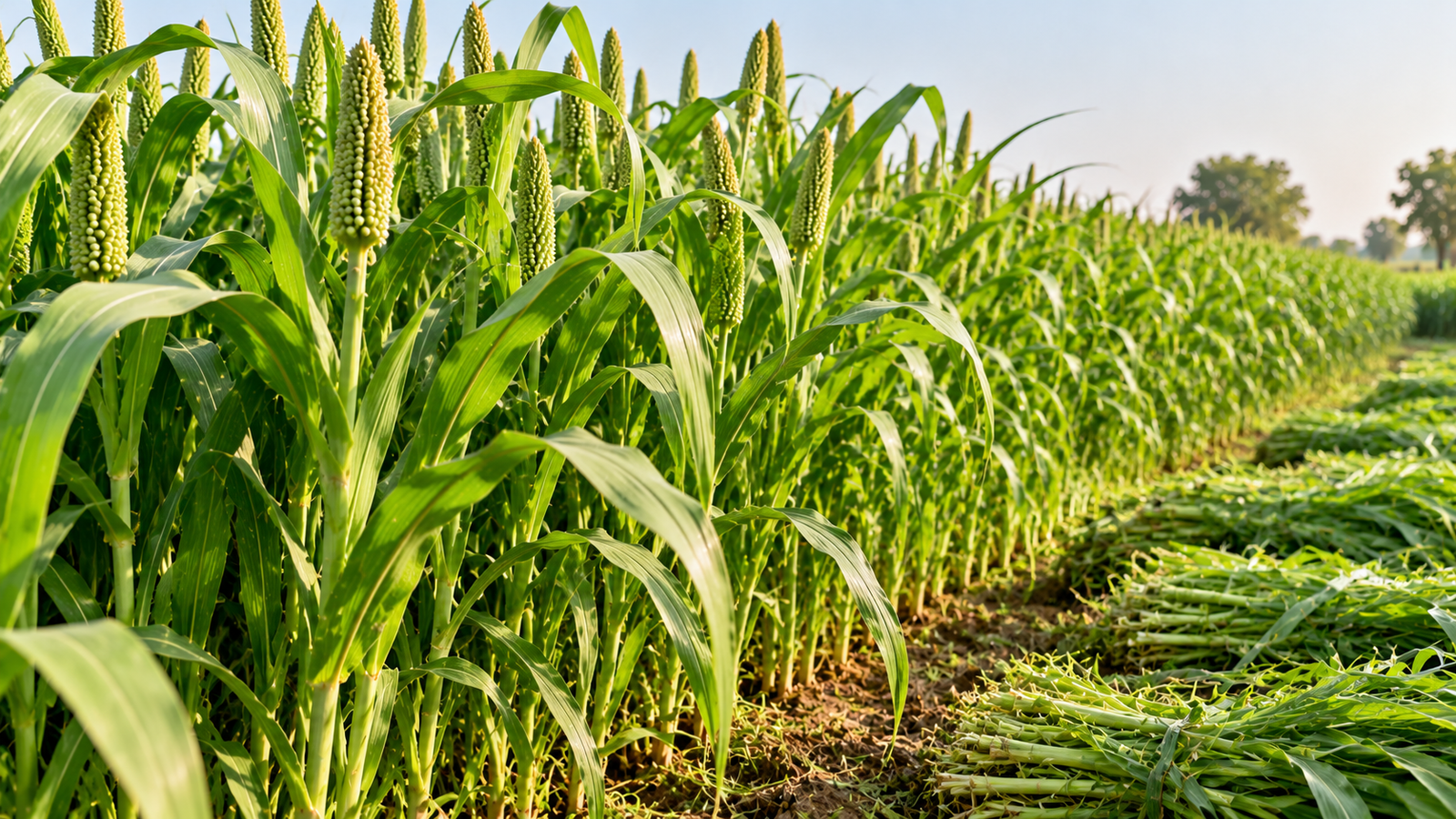
High-density multi-cut summer pearl millet stand producing lush, succulent green fodder.
Nutritional Profile: Why Dairy Farmers Choose Multi-Cut Bajra
Feeding multi-cut forage bajra to milking livestock delivers clear nutritional benefits compared to ordinary dry crop residues:
High Crude Protein (CP) Concentration: Multi-cut forage bajra harvested at the pre-boot stage maintains 10% to 12.5% crude protein on a dry-matter basis. This high protein level supports milk production while cutting the need for expensive commercial oilcake feeds.
Low Hydrocyanic Acid (HCN) Safety: Sorghum (Jowar) forage often carries high concentrations of toxic prussic acid (HCN) during early summer growth, which can poison livestock. In contrast, forage pearl millet remains completely free of prussic acid, making it safe to feed to animals at any growth stage.
Superior Leaf-to-Stem Ratio: High-performance forage hybrids produce wide, succulent leaves with thin, soft midribs. As a result, dairy cattle consume the feed completely with zero stem waste in feed troughs.
High Dry Matter Digestibility: Thin, tender stalks contain lower lignin concentrations, ensuring high in-vitro dry matter digestibility (IVDMD). This promotes efficient rumen fermentation, leading directly to higher butterfat test percentages at dairy collection centers.
Per Bigha Multi-Cut Tonnage & Yield Economics (Gujarat Basis)
Under precision irrigation and proper basal fertilization, multi-cut summer bajra yields high returns on a single Gujarat Bigha (approx. 0.4 acre):
Recommended Sowing Density: 3.0 kg to 4.0 kg of certified seed per bigha (approx. 8 kg to 10 kg per acre) to ensure a dense, weed-suppressing crop canopy.
First Harvest Yield (45 to 50 Days): Delivers 7,000 kg to 9,000 kg (7 to 9 tonnes) of fresh, tender green fodder per bigha.
Second Harvest Yield (75 to 80 Days): Produces 5,000 kg to 6,500 kg (5 to 6.5 tonnes) per bigha through aggressive ratoon basal tillering.
Third Harvest Yield (105 to 110 Days): Provides an additional 3,500 kg to 4,500 kg (3.5 to 4.5 tonnes) of valuable green fodder before monsoon field preparation begins.
Cumulative Season Tonnage: High-performing bajra seeds generate a cumulative output of 15 to 20 metric tonnes of nutritious green forage per bigha across three successive cuts.
Agronomic Practices for Maximizing Summer Multi-Cut Biomass
Achieving continuous, rapid ratoon regrowth requires following disciplined field management routines:
Well-Tilled Seedbed and Firm Packing: Summer heat evaporates moisture quickly from uncompacted topsoil. Prepare a fine, weed-free seedbed and follow sowing with a light wooden leveler to ensure close soil-seed contact. Review proper soil readiness strategies in our guide to seed germination.
Balanced Basal and Top-Dress Nitrogen Splits: Apply 25 kg of DAP and 15 kg of Potash per bigha during final land preparation. Top-dress 20 kg of Urea per bigha within 24 hours of each cutting to stimulate rapid tillering buds.
Pre-Sowing Seed Sanitation: Intense summer soil temperatures can encourage fungal root rots in damp, irrigated furrows. Applying the protective practices explained in our review of seed treatment benefits shields young seedling crowns from early soil-borne decay.
Calibrated Irrigation Intervals: Irrigate every 5 to 7 days during peak May heat. Maintain consistent moisture in the root zone, as moisture stress hardens stems and triggers premature heading.
Harvesting Milestones: Cutting Height and Ratoon Care
Managing cutting height is the most critical factor for securing successful second and third forage harvests:
First Cut Timing: Take the initial cut at 45 to 50 days post-sowing, when plants stand 3.5 to 4 feet tall and before any seed heads appear.
The 10-Centimeter Stubble Rule: Never harvest flush with the ground. Always cut stems 8 cm to 10 cm above the soil surface to preserve basal active nodes, which drive secondary tillering.
Immediate Irrigation After Cutting: Water the field within 24 to 48 hours following each harvest. Applying a light irrigation alongside top-dressed urea jumpstarts rapid ratoon growth within four days.
Subsequent Cutting Frequency: Take subsequent cuts every 28 to 32 days, before stems become fibrous and wood-like.
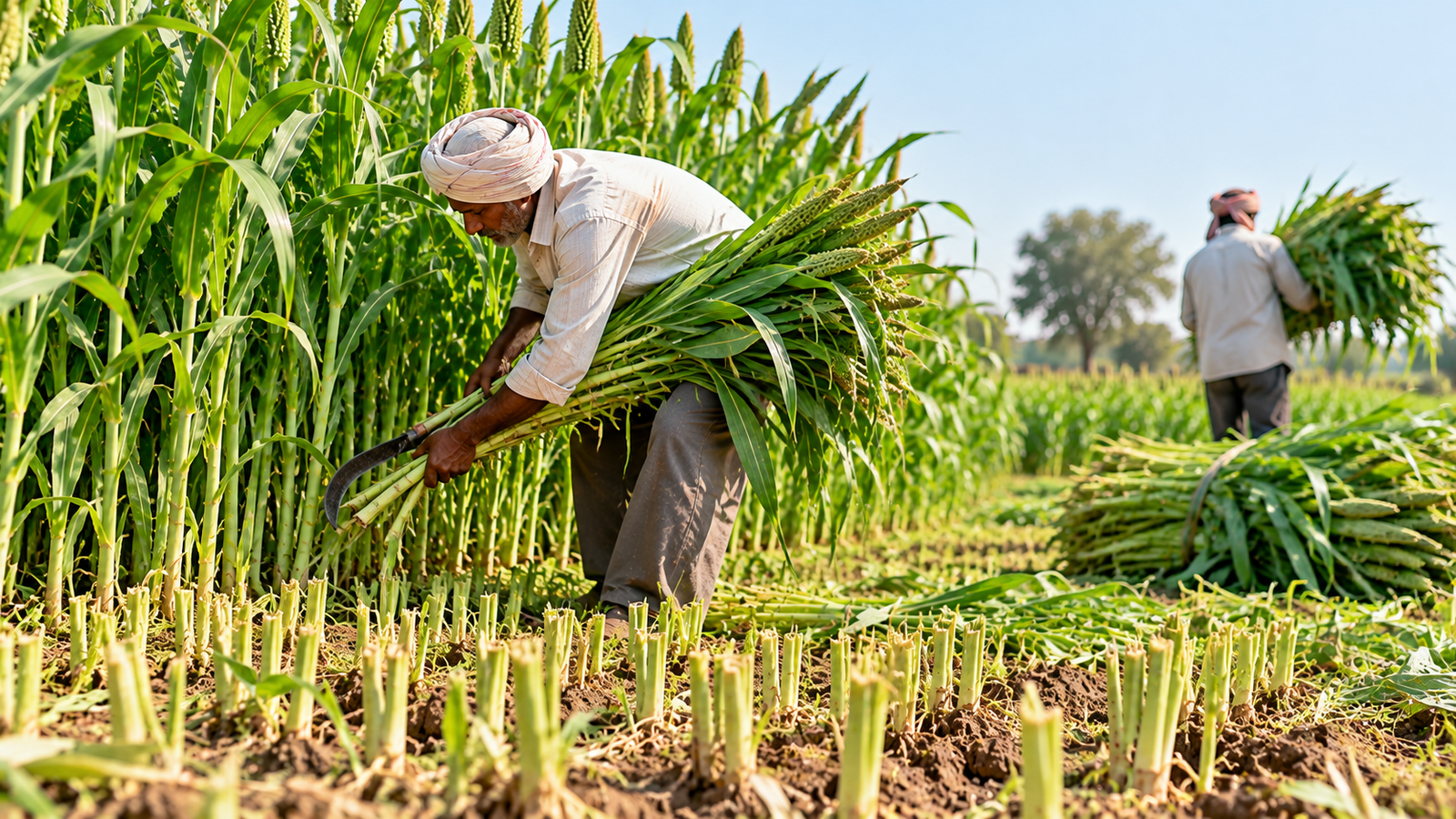
Manual harvest of fodder bajra leaving 10 cm stubble for vigorous multi-cut regrowth.
Strategic Crop Rotation Planning for Multi-Season Revenue
Integrating multi-cut summer bajra into broader seasonal crop rotations keeps fields productive and protects soil health:
Post-Rabi Rotation: Planting summer forage right after harvesting winter cumin seeds uses vacant field beds efficiently and prevents early summer weed infestations.
Saline Soil Adaptation: In areas with brackish well water where other fodder crops struggle, bajra tolerates moderate soil salinity while maintaining high green biomass.
Monsoon Oilseed Follow-Up: Following summer forage harvests, turning the field into high-yielding Groundnut Seeds enriches the soil with fixed atmospheric nitrogen.
Annualized Rotation Guidance: Farmers can review multi-season planting schedules in our detailed guide on season-wise crop planning.
4 Costly Mistakes That Reduce Multi-Cut Fodder Yields
Avoid these four common field mistakes that limit green forage yield and livestock performance:
Harvesting Stalks Flush with Ground Level: Cutting plants directly at ground level removes active regenerative nodes. Consequently, stubbles fail to produce secondary tillers, reducing the crop to a single harvest.
Delaying Harvest Until Flowering Head Emergence: Allowing seed heads to emerge hardens stalks and lowers crude protein content by over 40%. Always harvest at the vegetative pre-boot stage to preserve palatability.
Neglecting Nitrogen Fertilization After Cuts: Skipping nitrogen application following a harvest starves emergent ratoon tillers. Stalks grow slowly, stay pale, and yield less than half the expected second-cut tonnage.
Sowing Degenerated Farm Grains: Planting unverified seeds saved from past seasons results in uneven germination, thin stems, and zero ratoon tillering. Sourcing verified certified varieties from Akshay Seeds ensures high germination rates, rapid regrowth, and maximum forage tonnage.
Frequently Asked Questions (FAQs)
How many cuts can a farmer harvest from summer multi-cut bajra seeds?
With adequate irrigation and post-cut nitrogen management, high-performance hybrid summer bajra delivers 3 distinct cuts spaced 28 to 32 days apart.
What is the ideal cutting height for multi-cut fodder bajra?
Stems must be cut 8 cm to 10 cm above ground level. Leaving this stubble height preserves basal regenerative nodes, ensuring rapid second and third tillering cycles.
Is multi-cut bajra green fodder safe for all dairy animals?
Yes, forage pearl millet contains zero prussic acid (HCN) and low nitrate levels, making it safe for milking cows, buffaloes, calves, and small ruminants at any growth stage.
How much water does summer bajra require compared to fodder maize?
Summer bajra consumes 30% to 40% less irrigation water than fodder maize, showing high heat tolerance and thriving in temperatures above 42°C.
Secure High-Yield Multi-Cut Bajra Seeds for Summer
Maintaining milk production through hot summer months begins with choosing certified, high-tillering fodder seed genetics. Planting certified hybrid seed protects your forage investment, supports fast ratoon regrowth, and delivers the sweet, succulent green forage that dairy animals thrive on.
Secure your summer green fodder supply this season. Explore our certified forage and grain lines across the Akshay Seeds product catalogue, review real-world field results inside the Akshay Seeds media gallery, or contact our agronomy supply desk through our contact us portal to place your commercial seed orders today!