


Warning: foreach() argument must be of type array|object, bool given in /home/u780765189/domains/akshayseed.com/public_html/wp-content/themes/akshayseed/single.php on line 8
Gondal APMC Groundnut Rates 2026: Seed Quality Standards, Shelling Ratio & Farmer Profit Guide
Mastering Mandi Auction Quality: The Complete Gondal APMC Groundnut Rates & Seed Selection Guide
Selling groundnut (Arachis hypogaea) at competitive prices requires deep insight into terminal yard grading standards. Across Rajkot, Junagadh, Amreli, and Jamnagar districts, Saurashtra farmers actively track Gondal APMC Groundnut Rates to benchmark their seasonal crop earnings. As the primary oilseed trading hub of Western India, Gondal APMC determines benchmark spot prices that ripple across regional processing centers and global peanut export desks.
Securing maximum bids at the daily auction platform depends heavily on physical grain quality. Many agricultural producers arrive at the mandi yard with truckloads of produce only to receive disappointing auction offers. Furthermore, high pod moisture, sand contamination, hollow shells (popda), and dark mold blemishes prompt commission buyers to deduct thousands of rupees per trolley. Therefore, progressive kheduts understand that earning premium auction rates begins months earlier by sowing clean, certified seed stock.
Pioneering seed breeding institutions like Akshay Seeds develop high-performance groundnut lines engineered specifically to meet stringent mandi expectations. Planting verified foundation seeds ensures high pod uniformity, high shelling recovery, and bright golden-yellow shells. Consequently, growers maximize their seasonal returns at the auction ring.
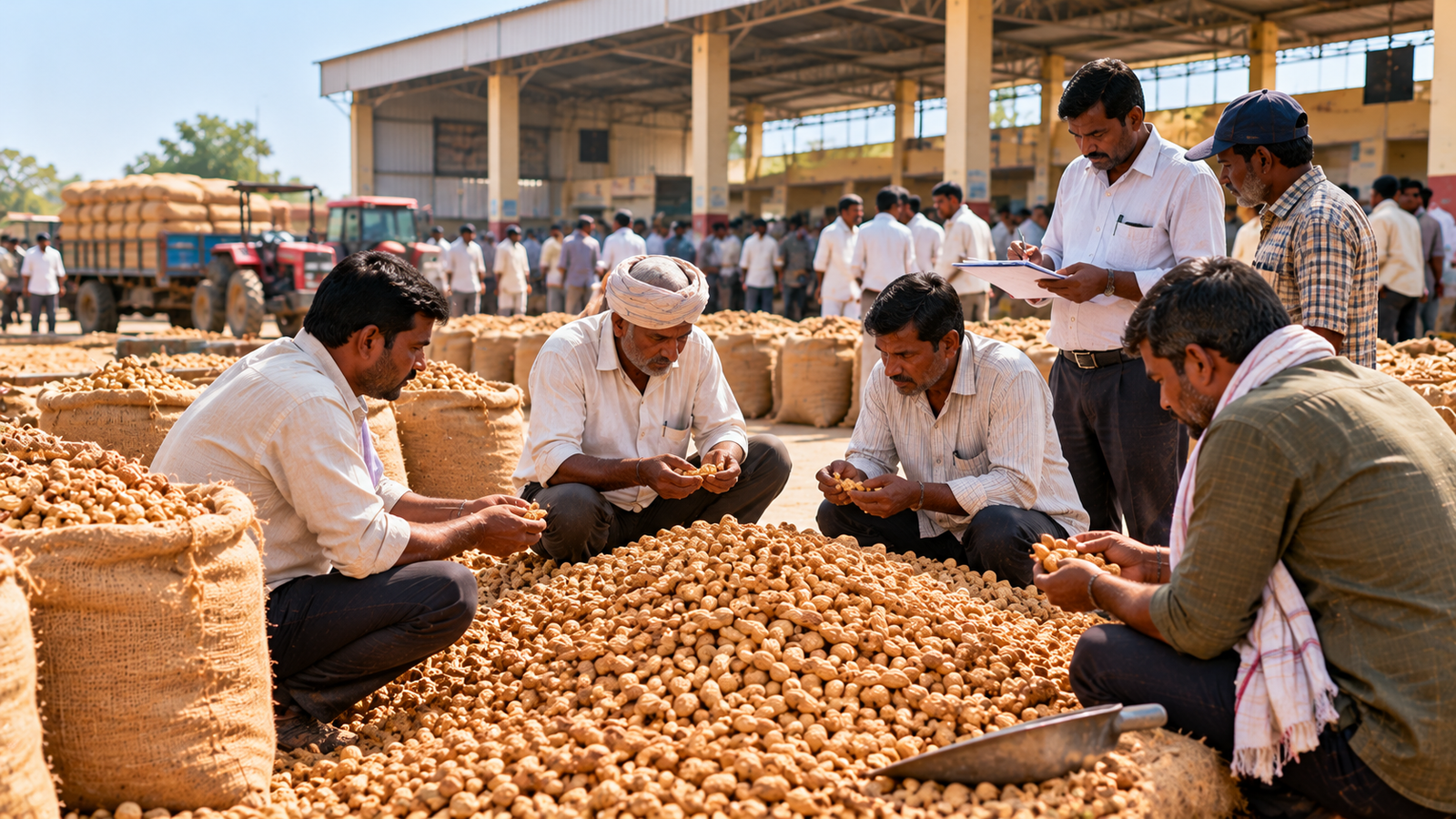
Traders inspecting bold peanut pod samples on the auction floor at Gondal APMC yard.
Inside Gondal APMC: How Groundnut Bids Are Decided
Commission agents (vyaparis) and corporate peanut shellers evaluate incoming groundnut heaps using practical grading benchmarks:
The Visual Pod Sample Check: Buyers take handfuls of pods from different depths of the tractor trolley. They look for uniform pod size, prominent reticulation (outer ridges), and complete absence of blackened shells.
The Manual Hand-Crack Test: Traders crack open random pods by hand on the spot. Lots with thin, crisp shells and two well-developed, pink, oil-rich kernels immediately trigger higher starting bids.
Hollow Pod Percentage (Popda): Unfilled, empty pods reduce commercial weight during industrial processing. A lot containing more than 4% hollow shells faces steep price penalties per 20 kg (one mann).
Foreign Matter Admixture: Sand, dry root clumps, and broken shell fragments force buyers to calculate extra mechanical cleaning costs, reducing gross offers.
Physical Quality Metrics That Dictate Top Mandi Prices
To consistently fetch top-tier auction rates at Gondal, your harvested produce must meet four vital parameters:
Shelling Ratio (Outturn Percentage): Industrial buyers demand a minimum shelling outturn of 70% to 74%. That means 100 kg of unshelled pods should yield at least 70 kg of whole, clean kernels.
Moisture Content at Delivery: Groundnut lots entering the yard must register under 7.0% to 8.0% moisture. Moist pods spoil quickly in bulk warehouse storage, inviting price cuts.
Complete Absence of Aflatoxin: Humid storage and late-season overwatering foster Aspergillus flavus mold, producing toxic aflatoxin. International export processors discard moldy lots entirely.
Bold Kernel Density: Large, elongated kernels command higher export rates. Farmers can ensure even early root establishment and strong pod filling by studying our guide to seed germination.
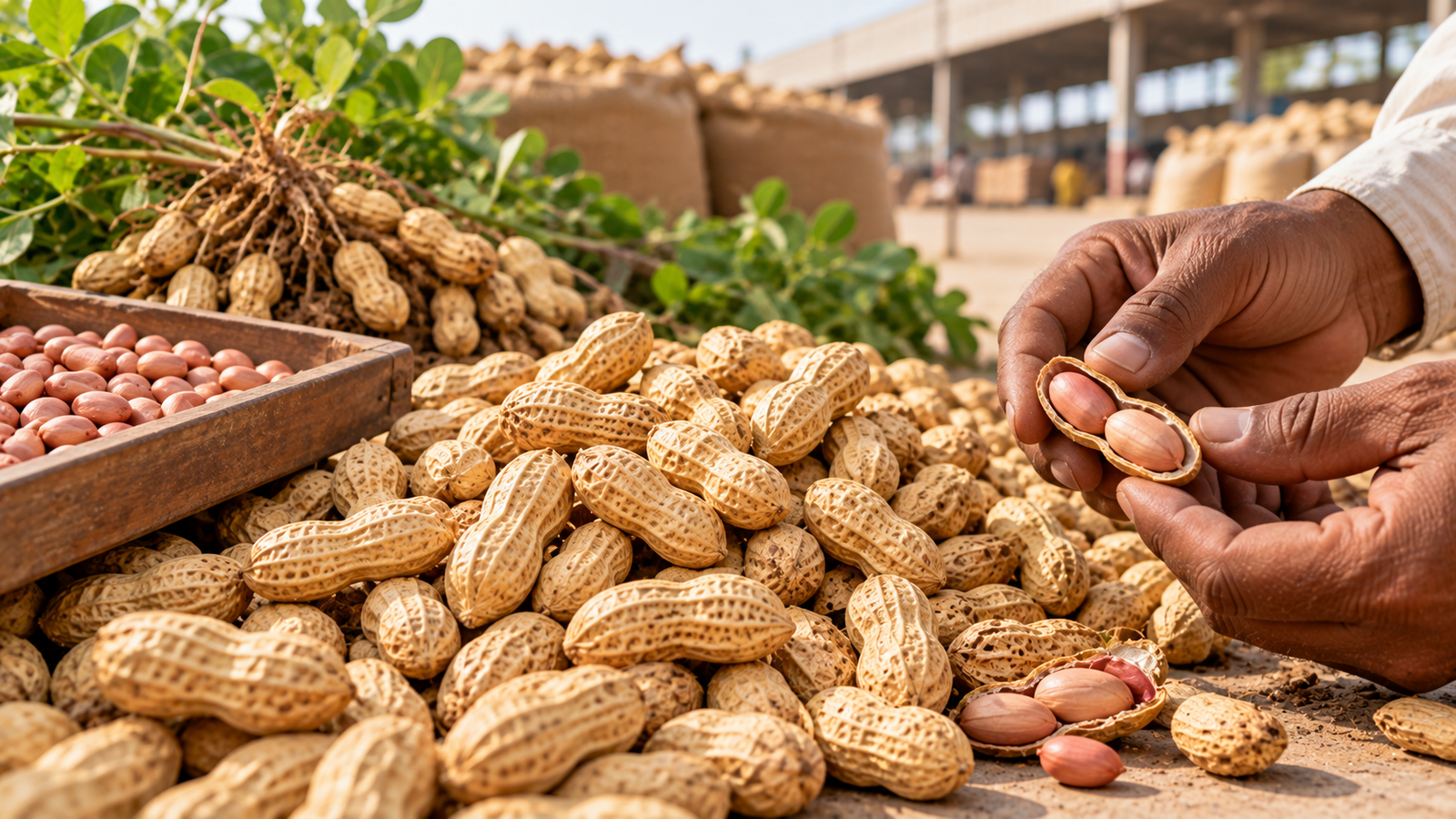
Clean, uniform two-kernel groundnut pods displaying bright shells and zero aflatoxin damage.
Field Economics: High-Yield Research Seeds vs. Uncleaned Grains
Using certified seed varieties directly drives final profitability at the Gondal auction ring:
Pod Uniformity Advantage: Sowing uncleaned, farm-saved grain produces irregular pod maturity, leaving many pods half-filled at harvest. In contrast, certified Groundnut Seeds mature simultaneously, maximizing double-kernel counts.
Higher Price per Mann (20 kg): Premium bold lots consistently earn Rs 50 to Rs 120 more per mann compared to ordinary mixed grains.
Vigorous Disease Tolerance: Research seed lines resist destructive soil fungi like collar rot and stem rot (Sclerotium rolfsii). Farmers can further shield emergent seedlings by applying the proven methods explained in our review of seed treatment benefits.
Substantial Yield Gains: Certified seed lines routinely produce 18 to 24 quintals per acre under optimal management, outperforming unselected local stock by up to 35%.
Cultural Field Management for Higher Pod Quality
Achieving export-grade groundnut pods requires disciplined field management right through harvest:
Sufficient Gypsum Application: Apply 200 kg to 250 kg of agricultural gypsum per acre at the flowering and pegging stage (35 to 40 days post-sowing). Calcium is essential for hard pod shells and prevents hollow-heart kernel defects.
Strict Harvest Timing: Inspect pod interiors by scratching the inner shell wall. When the inner shell turns dark brown to black, the crop is ready for harvest. Harvesting prematurely results in wrinkled, lightweight kernels.
Shaded Inverted Threshing: After uprooting, arrange harvested plants in inverted windrows with pods facing upward to sun-dry for 3 to 4 days. This prevents pod contact with damp soil, safeguarding shell color.
Proper Storage Packaging: Never bag warm or damp pods in unventilated plastic sacks. Store dried pods in clean jute bags raised on wooden pallets inside dry warehouses.
Strategic Multi-Season Crop Rotations for Saurashtra
Sustaining fertile, productive groundnut soil requires rotating fields across diverse crop families:
Rabi Cash Crop Transitions: After harvesting Kharif groundnut, sowing high-value cumin seeds takes advantage of residual soil tilth and reduces land prep expenses.
Saline Soil Adaptation: In farming belts with brackish tube-well water, following groundnuts with hardy mustard seed delivers steady winter revenue.
Nutrient Balancing with Cereals: Rotating with drought-tolerant bajra seeds cleanses the soil profile of persistent broadleaf weeds while supplying livestock feed.
Seasonal Strategy Execution: Developing a synchronized planting timeline is easy when following the operational framework in our guide on season-wise crop planning.
4 Common Post-Harvest Mistakes That Lower Mandi Rates
Avoid these four common mistakes that drag down lot bids at the Gondal market:
Threshing with Incorrect Rotor Speeds: Setting the tractor thresher drum too fast cracks outer shells and bruises inner kernels. Cracked pods sell at steep industrial discounts.
Washing Harvested Pods with Water: Washing dirt off pods with water raises moisture and invites rapid internal fungal decay. Clean pods using mechanical dry screens instead.
Combining Early and Late Pickings: Mixing premature, shriveled pods with fully mature bold pods drags the entire lot down to an average grade. Keep distinct pickings separate.
Sowing Degenerated Farm Grains: Planting unverified seeds saved from past seasons guarantees low shelling ratios and high disease incidence. Sourcing authentic foundation seeds from Akshay Seeds ensures high germination, high oil content, and top auction bids.
Frequently Asked Questions (FAQs)
What is the ideal shelling percentage for top groundnut rates at Gondal APMC?
The top commercial price bracket requires a shelling ratio between 70% and 74%, indicating thin shells and dense, plump twin kernels.
How does gypsum application improve groundnut market rates?
Gypsum supplies readily available calcium directly to developing pegs, ensuring thick, uniform shell formation and eliminating empty, hollow pods.
Why do buyers discount groundnut lots with high moisture?
Pods with moisture above 8% develop mold and aflatoxin during storage, ruining entire warehouse consignments. Buyers deduct bids to cover immediate mechanical drying costs.
What is the standard trading weight unit at Gondal APMC?
Groundnut and other agricultural commodities at Gondal APMC are auctioned per mann (equivalent to 20 kilograms) or per quintal (100 kilograms).
Secure Top Mandi Prices with Certified Groundnut Seeds
Achieving the highest auction prices at Gondal APMC begins with planting pure, certified seed genetics. High-grade seed stock protects your input capital, resists soil-borne wilt, and delivers the bold, high-shelling pods demanded by leading spice and oilseed merchants.
Maximize your agricultural earnings this season. Explore our certified seed varieties across the Akshay Seeds product catalogue, view real-world field trials in our Akshay Seeds gallery, or contact our technical sales team via our contact us portal to secure your high-yield groundnut seed stock today!
