


Warning: foreach() argument must be of type array|object, bool given in /home/u780765189/domains/akshayseed.com/public_html/wp-content/themes/akshayseed/single.php on line 8
Drip Irrigation Seed Rate and Spacing Guide for Groundnut and Bajra: Save Water and Maximize Yield
Transitioning from traditional flood irrigation to micro-irrigation systems is transforming modern farming in Western India. Across Saurashtra, Kutch, and North Gujarat, forward-thinking farmers actively optimize the Drip Irrigation Seed Rate to reduce pumping costs and maximize harvest tonnage. Groundnut (Arachis hypogaea) and pearl millet (Pennisetum glaucum), widely known as bajra, respond exceptionally well to micro-irrigation, yielding significantly higher output when plant population matches inline emitter spacing.
Securing maximum efficiency under drip lateral lines requires re-calibrating traditional seeding densities. Many growers make the mistake of using standard broadcast seed rates on raised drip beds. Consequently, dense canopy crowding restricts lateral air movement, invites stem rot (Sclerotium rolfsii), and increases pest vulnerability. Conversely, under-seeding leaves expansive light gaps along dripper lines, wasting expensive pressurized water on unutilized soil. Therefore, progressive kheduts adopt calibrated row-to-row and plant-to-plant geometries matched to emitter discharge rates.
Breeding institutions like Akshay Seeds develop high-vigor hybrid seeds optimized for precision field planting. Sourcing uniform, lab-tested foundation seed ensures rapid root growth along drip wetted zones. As a result, farmers eliminate re-sowing labor while cutting total water usage by up to 40%.
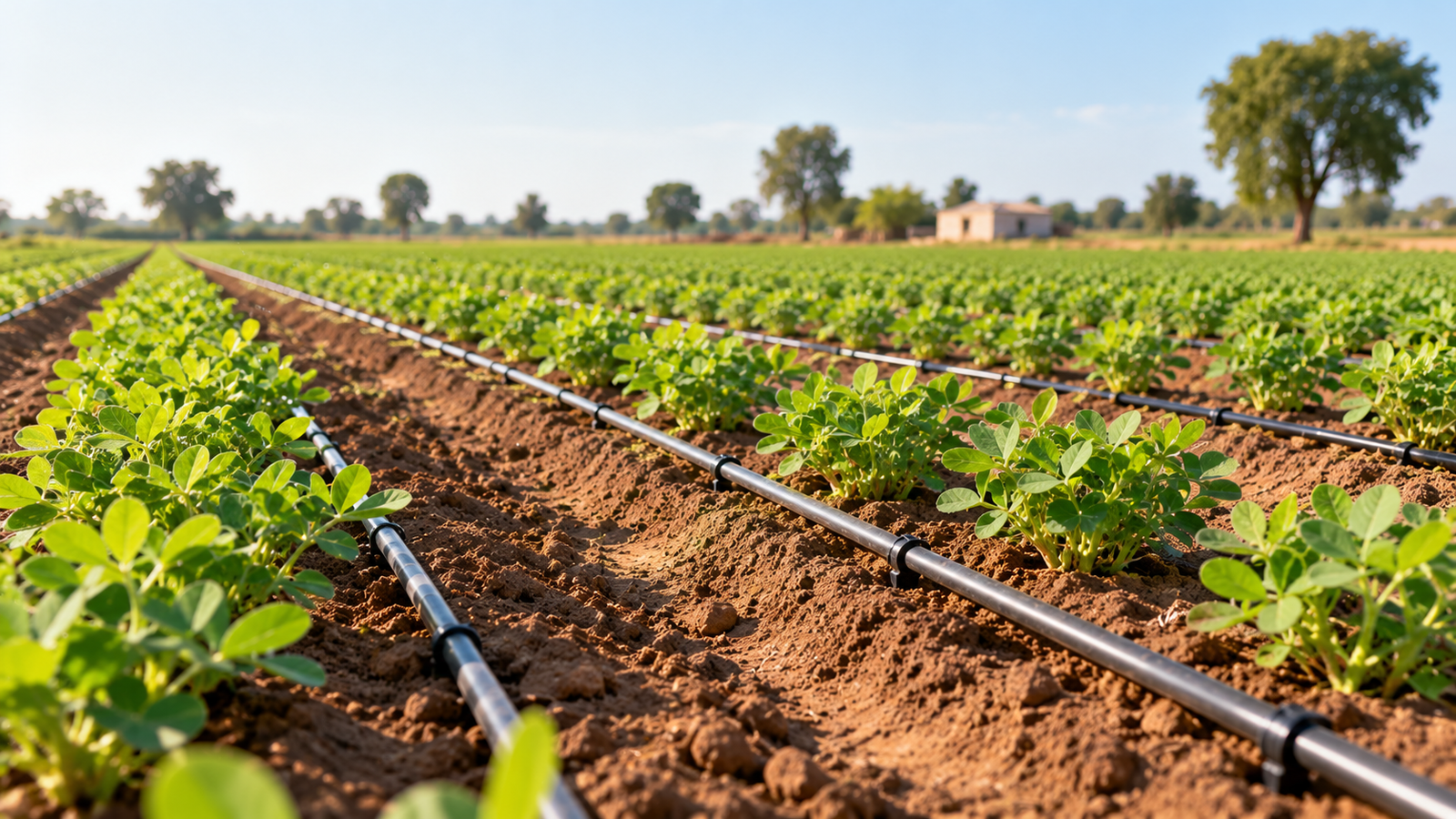
Precision drip lateral spacing laid out for row-to-row groundnut planting in Gujarat.
Technical Agronomy: Why Drip Changes Plant Population Density
Switching to inline drip laterals requires a fundamental rethink of plant population dynamics:
Targeted Root Zone Hydration: Flood irrigation saturates the entire field surface, losing up to 50% of water through deep percolation and evaporation. In contrast, drip laterals deliver moisture directly to the active root collar, supporting closer in-row plant spacing without water stress.
Controlled Canopy Aeration: Drip lines leave furrow walkways dry, lowering relative humidity inside the lower foliage. This drier microclimate reduces fungal foliar blights, allowing growers to maintain higher plant populations safely.
Uniform Seedling Emergence: Constant moisture tension within the wetting bulb triggers rapid germination across all rows. Reviewing seedbed preparation protocols in our guide to seed germination helps growers establish an even, vigorous plant stand.
Maximized Fertigation Efficiency: Water-soluble fertilizers injected directly through venturi systems target the root zone instantly. Consequently, crops develop thicker stems, deeper taproots, and higher pod-filling capacity per square meter.
Groundnut Spacing Chart & Drip Seed Rate Calculator
Groundnut requires adequate space for gynophores (pegs) to penetrate the soil easily around the main taproot:
Recommended Spacing Geometries for Groundnut
Paired Row System (Recommended): Bed width of 90 cm with two crop rows spaced 30 cm apart on the bed, leaving a 60 cm furrow between beds.
Plant-to-Plant (In-Row) Spacing: 10 cm between plants along the drip wetted strip.
Drip Lateral Arrangement: One 16 mm inline lateral line running down the center of each paired row bed.
Emitter Spacing & Discharge: Drippers placed 30 cm to 40 cm apart with a flow rate of 2.0 to 2.4 liters per hour (LPH).
Calibrated Seed Rate per Acre
Bunch (Erect) High-Yield Types: 40 kg to 45 kg of certified kernels per acre (approx. 16 kg to 18 kg per Gujarat Vigha).
Semi-Spreading Varieties: 35 kg to 38 kg of graded seed per acre.
Why Certified Seed Matters: Investing in high-germination Groundnut Seeds guarantees uniform plant stand density without hollow patches along the drip lateral.
Bajra Spacing Chart & Drip Seed Rate Calculator
Pearl millet produces vigorous tillering when given proper light and water, requiring adjusted seeding rates under drip irrigation:
Recommended Spacing Geometries for Bajra
Row-to-Row Spacing: 45 cm to 60 cm between rows on flat or broad bed layouts.
Plant-to-Plant Spacing: 12 cm to 15 cm within the row after early thinning.
Drip Lateral Layout: One inline lateral placed between every two crop rows (skip-row drip arrangement).
Emitter Specifications: Drippers spaced at 40 cm intervals with a delivery rate of 2.0 LPH.
Calibrated Seed Rate per Acre
Grain & Multi-Cut Hybrid Seeds: 1.5 kg to 2.0 kg of graded seed per acre (approx. 600 g to 800 g per Vigha).
Direct Advantage over Broadcasting: Traditional manual broadcasting consumes 3.5 kg to 4.5 kg per acre, creating crowded, spindly stalks. Precision drilling under drip saves up to 50% on seed costs while producing thick, lodging-resistant stems.
Vigor Assurance: Using certified bajra seeds ensures uniform, multi-tillering growth along every dripper point.
Precision Fertigation & Moisture Scheduling Milestones
Drip systems provide maximum yield gains when irrigation runtime matches crop developmental stages:
Sowing to Germination: Run the drip system for 2 to 3 hours prior to sowing to establish a continuous wet strip. Apply a light 45-minute cycle two days after sowing to soften the top crust for emerging shoots.
Vegetative & Branching Stage: Irrigate every 2 to 3 days for 1.5 to 2 hours, keeping soil moisture tension at field capacity.
Groundnut Pegging & Pod Formation: Maintain continuous light moisture cycles. Soil crusting during peg entry causes pegs to bend and dry out, slashing total pod counts.
Disease Prevention Through Seed Treatment: Moisture around drippers can harbor soil pathogens if seeds are untreated. Applying protective treatments detailed in our guide on seed treatment benefits protects root collars against collar rot and wilt.
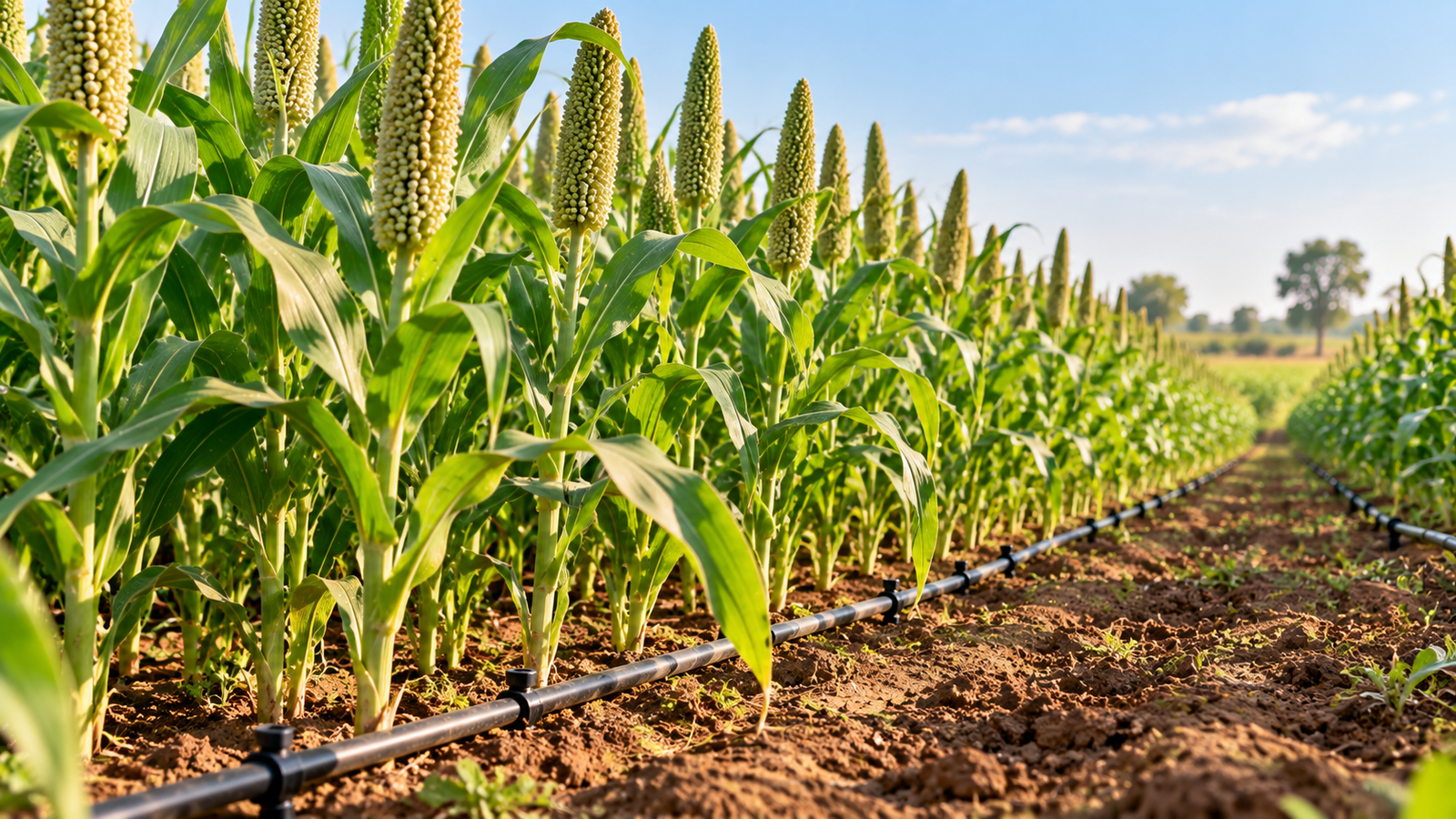
High-density bajra crop irrigated with inline drippers for high biomass and grain yield.
Sustainable Multi-Season Crop Planning Framework
Integrating drip irrigation infrastructure across sequential crops improves capital returns and maintains soil health:
Kharif to Rabi Transition: Following monsoon groundnut, utilizing existing drip laterals for winter cumin seeds reduces seasonal land preparation and pipe-laying labor.
Saline Soil Adaptation: In areas with slightly saline tube-well water, running drip lines with resilient crops like mustard seed prevents salt buildup in the root zone.
Summer Legume Breaks: Planting short-duration Green Gram Seed on drip beds before monsoon sowing enriches the soil with fixed atmospheric nitrogen.
Annualized Rotation Guidance: Farmers can review multi-season planting schedules in our detailed guide on season-wise crop planning.
4 Common Drip Seeding Mistakes That Hurt Crop Yields
Avoid these four common operational errors when planting groundnut and bajra under drip systems:
Sowing Seeds Directly on Top of the Lateral Line: Placing seeds directly under the plastic pipe causes emergent shoots to hit the lateral, bending seedlings and misaligning rows. Always sow 5 cm to 7 cm to the side of the lateral.
Skipping Post-Emergence Thinning in Bajra: Failing to thin crowded bajra seedlings within 15 days of emergence produces thin, weak stalks that lodge under heavy winds. Thin early to maintain 12 cm to 15 cm between plants.
Running High Pressure Without Filtration: Pumping water through uncleaned disc or screen filters clogs emitters, creating dry gaps where seeds fail to germinate. Clean filters weekly.
Using Degenerated Local Farm Seed: Planting uncleaned grain leads to variable seed size, causing uneven drop rates in tractor planters and poor germination under drippers. Sourcing certified foundation seed from Akshay Seeds ensures uniform seed size, high germination rates, and consistent field stands.
Frequently Asked Questions (FAQs)
How much water does drip irrigation save in groundnut and bajra farming?
Drip irrigation reduces water consumption by 35% to 45% compared to flood irrigation, while boosting overall crop yields by 20% to 30% through targeted root delivery.
What is the ideal lateral-to-lateral spacing for groundnut on raised beds?
The optimal layout uses broad beds spaced 90 cm apart from center to center, with one drip lateral running down the middle serving two groundnut rows spaced 30 cm apart.
Can bajra be successfully grown using drip irrigation during summer?
Yes, summer bajra performs exceptionally well under drip irrigation. The controlled water supply prevents heat stress, supports rapid tillering, and maximizes green fodder tonnage.
Why is the seed rate lower under drip irrigation than flood irrigation?
Drip irrigation ensures uniform moisture along the entire row, delivering 90%+ field emergence. This high germination efficiency eliminates the need for excess seed to compensate for dry soil patches.
Upgrade to Certified Seeds for High-Yield Drip Farming
Maximizing returns from your drip irrigation investment begins with planting clean, certified seed genetics. Sourcing high-purity seed stock protects your input capital, ensures uniform germination along drip lines, and delivers the bold grains and high pod counts that drive market profits.
Optimize your drip farm yields this season. Explore our complete agricultural portfolio across the Akshay Seeds products directory, view proven field results in our Akshay Seeds gallery, or contact our agronomy advisory team through our contact us portal to secure your certified planting stock today!
